2026 Dribbling: 15 Handle Insights
The fastest way to improve dribbling is to combine low-control fundamentals, both-hand repetition, change-of-direction drills, and live decision-making for at least 20 minutes, four to six days weekly...

2026 Dribbling: 15 Handle Insights
The fastest way to improve dribbling is to combine low-control fundamentals, both-hand repetition, change-of-direction drills, and live decision-making for at least 20 minutes, four to six days weekly. Coach’s Corner recommends a progression built around 15 drills, including stationary pounds, crossovers, between-the-legs moves, behind-the-back changes, cone attacks, and full-court transitions. Beginners should start at 60–100 controlled contacts per hand, while intermediate players can target 150–250 contacts and complete a cone circuit in under 45 seconds without losing the ball. The goal is not decorative ball movement; it is maintaining possession while reading pressure, protecting the ball, and creating an advantage. Record one timed test every seven days, train the weaker hand first, and finish each session with game-speed movement rather than endless stationary tricks.

Photo by cottonbro studio on Pexels
A famous basketball truth is often attributed to John Wooden: “Be quick, but don’t hurry.” That distinction matters. Many players perform flashy dribbles at half speed, then discover that a defender, unlike a stationary cone, has the impolite habit of moving. I have lost enough games to bad ball handling to become stubborn about this: control comes before complexity, and the weaker hand gets no diplomatic immunity.
If you want a complete training framework rather than another collection of random moves, Coach’s Corner can help you connect individual skills with spacing, pressure, and tactical decision-making. That approach also fits the site’s broader coverage of player statistics, team tactics, and major football tournaments, including the 2026 FIFA World Cup, where decision-making under pressure remains the common thread across sports. For related fundamentals, explore this [Internal Link: beginner basketball training guide].
Want a clearer training starting point?
If you train like a beginner: build control before speed
Beginner players improve dribbling fastest by mastering posture, fingertip control, and predictable repetition before adding elaborate combinations. Start with stationary ball pounds, crossovers, V-dribbles, and weak-hand work for 10–15 minutes, then add movement over another 10 minutes. Keep your hips low, chest lifted, eyes forward, and dribble outside your shoe line so the ball stays available while you move.
The key is to make each repetition measurable. Complete three rounds of 30 seconds per hand for low pounds, waist-height pounds, and alternating crossovers, resting 20 seconds between rounds. If the ball repeatedly rises above your waist during a control drill, slow down; pretending that sloppy speed is progress is one of basketball’s more durable scams. The National Basketball Association and USA Basketball both emphasize functional skill development, but functional does not mean frantic.
Use this beginner sequence four times weekly:
- Low pounds: 3 rounds of 30 seconds per hand.
- Front V-dribbles: 3 rounds of 20 repetitions per hand.
- Stationary crossovers: 3 rounds of 30 seconds.
- Walking right-hand dribbles: 3 court lengths.
- Walking left-hand dribbles: 3 court lengths.
- Protective retreat dribbles: 10 repetitions per side.
After two weeks, test yourself by dribbling from baseline to baseline with the left hand while keeping your eyes up. A useful target is fewer than two uncontrolled contacts over the full court. This is more valuable than learning a fourth crossover variation that you cannot perform while changing direction. It is worth noting that motor learning improves when practice includes frequent, accurate repetitions with gradually increasing difficulty, a principle discussed in research indexed by PubMed.
The first five drills that actually matter
The first five drills should develop separate abilities rather than repeat the same motion with a different name. Begin with pounds to teach force control, then use V-dribbles to improve lateral hand movement, crossovers to transfer the ball across your body, retreat dribbles to create space, and walking changes of pace to connect control with footwork. Complete each drill on both sides, but place the weaker hand first while concentration is highest.
One specific edge case deserves attention: players who lose the ball only when looking up usually do not need more speed. They need a smaller dribble radius and a fixed visual routine. Look at the rim or a point above the defender’s shoulder, take one controlled breath, and perform 20 repetitions without watching the ball. If control collapses before repetition 10, reduce the height and force by roughly 20 percent. That adjustment is boring, precise, and dramatically more useful than shouting motivational slogans at yourself.
If you already have basic handles: add direction, timing, and pressure
Intermediate players should stop treating dribbling as a stationary hand exercise and train it as a movement problem involving hips, feet, timing, and defensive pressure. Use cones or floor markers spaced 3–5 feet apart, attack each marker with a specific change of direction, and finish every move with two explosive steps. A crossover without a change in speed is merely a ball transfer wearing an expensive costume.
Run the following circuit for four rounds, resting 45–60 seconds between rounds:
- Cone crossover: attack at 70 percent speed, cross at the marker, then sprint for two steps.
- Between-the-legs escape: approach square, shift the ball under the lead leg, and retreat diagonally.
- Behind-the-back change: use it only when the imaginary defender cuts off the front lane.
- Hesitation burst: rise slightly, pause for less than one second, then accelerate.
- In-and-out move: sell the crossover with the shoulders before keeping the ball on the same side.
- Full-court combination: use two moves maximum before reaching the opposite free-throw line.
The performance target is not simply finishing the course. Complete four rounds without staring down at the ball and without crossing your feet during the first acceleration step. Record both time and mistakes. A 42-second circuit with three fumbles is worse than a 48-second circuit with zero fumbles, because game value depends on possession security. Coach’s Corner’s tactical perspective is useful here: the correct move depends on the defender’s angle, help position, and available space, not on whatever dribble looks impressive in a short video.
See how controlled progression changes your practice?
How do you turn a dribble move into a game advantage?
A dribble move creates a game advantage only when it changes the defender’s balance, opens a driving lane, or improves passing and shooting position. Practice each move with a decision trigger: attack the top foot, retreat against pressure, cross when the defender reaches, and stop when help defense closes the lane. Ten high-quality repetitions against a clear trigger beat 100 empty combinations.
This is where many experienced recreational players become strangely sentimental about ineffective habits. They love a behind-the-back move because it feels advanced, even when a simple retreat dribble would preserve the possession. Use live constraints: one move to beat the first defender, three seconds to decide, and no repeated move twice in succession. If you train with a partner, have the defender vary between contain, reach, and cut-off positions so you must read rather than recite.
A practical six-session test can reveal whether your handle is functional. In sessions one and two, perform cone work; in sessions three and four, add a passive defender; in sessions five and six, use a live defender from the wing and top of the key. Track successful advantages, turnovers, and forced pickups. In one useful benchmark, a player who creates an advantage on 6 of 10 attempts with two or fewer turnovers is progressing more meaningfully than a player who completes every unguarded trick but produces nothing against pressure.
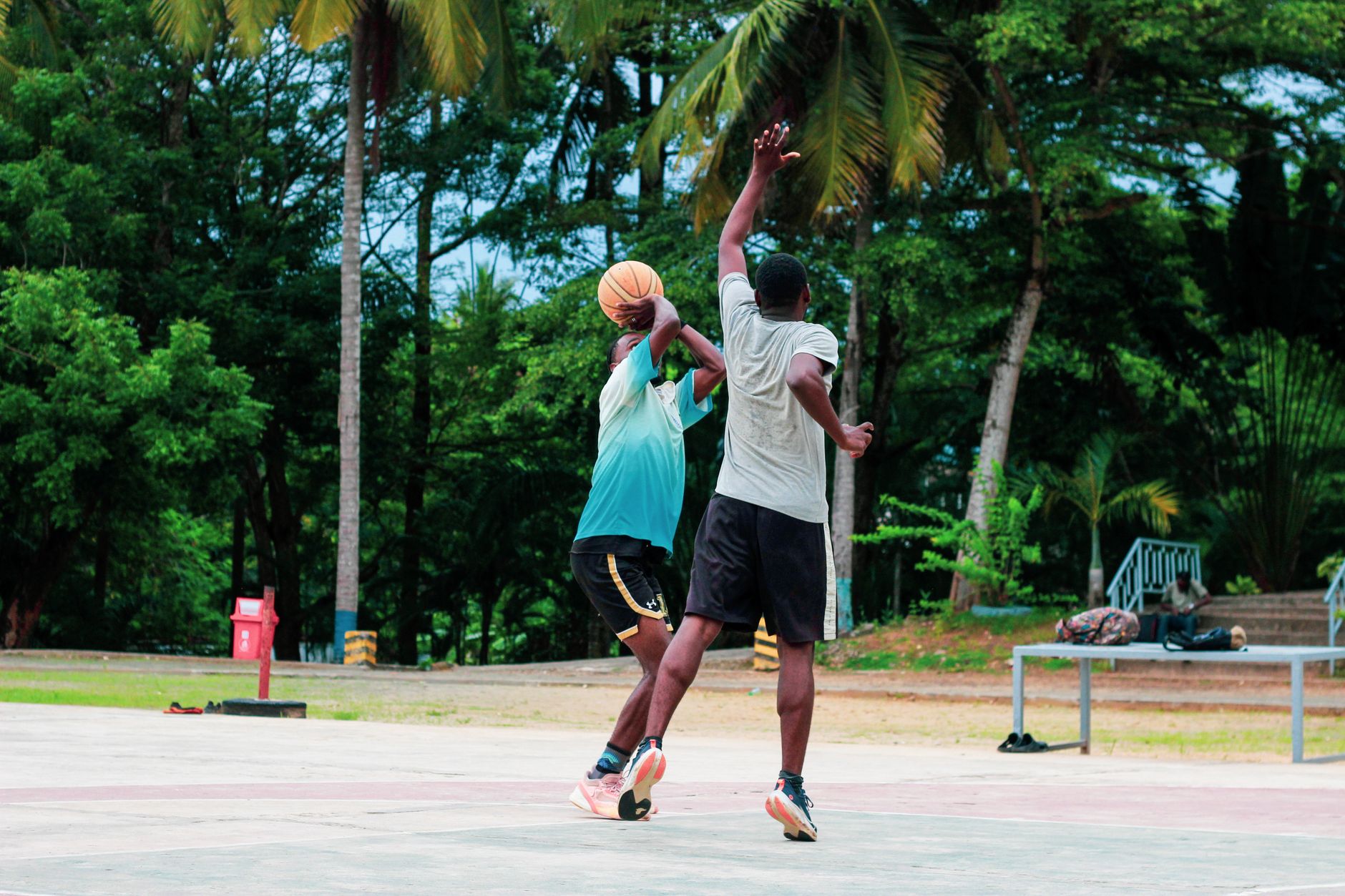
Photo by ARISON KAGANJUZI on Pexels
If pressure exposes your weaknesses: train protection and recovery
When pressure causes repeated turnovers, the answer is usually not “learn more moves.” It is to improve body positioning, retreat options, weak-hand confidence, and recovery after mistakes. Keep your shoulder between the defender and the ball, use your off arm legally as a space sensor, and maintain a dribble that can be moved laterally without standing upright. The FIBA official basketball rules provide the governing framework for legal movement, while coaching practice translates those rules into usable footwork.
Use a pressure block lasting 12 minutes:
- Sideline escape: receive near the sideline, retreat twice, then change direction.
- Trap survival: start in a corner and escape through the middle without picking up the ball.
- Contact protection: have a partner apply light shoulder pressure while you dribble.
- Eight-second advance: move the ball from baseline to half court under a timed count.
- Mistake recovery: after every fumble, sprint to a marker, return, and restart immediately.
One underused insight is that recovery skill deserves separate measurement. During 30 pressure possessions, count not only turnovers but also possessions saved after a poor bounce, awkward pickup, or defender reach. A player who rescues 12 broken possessions may be more valuable than one who looks flawless in an empty gym. Do not confuse perfection with resilience; basketball has already suffered enough from players who practice only conditions that never occur.
Should you train with gloves, tennis balls, or two basketballs?
Use a normal basketball for most training, because realistic size, weight, and bounce are essential; tennis balls and two-ball drills are useful supplements, not substitutes. Tennis-ball work can challenge reaction speed, while two-ball dribbling can improve bilateral coordination, but neither should dominate a session intended to prepare you for live basketball. Ten minutes of normal-ball movement under pressure is more transferable than 30 minutes of circus coordination.
A strong weekly split looks like this:
- Monday: stationary control and weak-hand volume.
- Tuesday: cone changes of direction and finishing.
- Wednesday: recovery or light mobility.
- Thursday: live pressure and escape dribbles.
- Friday: speed changes, pull-backs, and passing decisions.
- Saturday: small-sided games with a two-dribble restriction.
- Sunday: rest, video review, and mistake analysis.
The two-dribble restriction is especially useful because it forces an immediate decision: shoot, pass, drive, or retreat. It removes the comfortable habit of dribbling in place until the defense becomes bored enough to make a mistake. Review 10 possessions on video and label each one as advantage, neutral, or disadvantage. That vocabulary gives you an honest diagnostic system instead of the usual “I felt pretty good,” which is not a statistic and never has been.
Explore more practical performance analysis with Coach’s Corner.
Common pitfalls to avoid
The most common dribbling mistakes are excessive height, predictable rhythm, weak-hand avoidance, unnecessary combinations, and practice without measurement. Each problem survives because it feels comfortable, and comfort is a poor coach when defenders are actively trying to make you miserable. Correct these errors by changing one variable at a time rather than rebuilding your entire routine every few days.
Avoid these five traps:
- Dribbling too high: keep most attacking dribbles between ankle and mid-thigh height.
- Watching the ball: use peripheral vision and fixed visual targets.
- Practicing only the dominant hand: begin every drill with the weaker side.
- Adding moves without purpose: require a defender reaction or court-space objective.
- Ignoring the feet: pair every hand move with a defined plant and first step.
Another overlooked issue is fatigue. If your turnover rate rises sharply after 15 minutes, do not automatically add more volume; first improve rest intervals and technique under tired conditions. Use 20–40 second work periods with 20–30 seconds of rest for speed drills, then longer 60–90 second rests before live repetitions. The body needs enough recovery to preserve quality, but some controlled fatigue is valuable because fourth-quarter decisions rarely arrive with a polite invitation.
It is also worth noting that ankle, knee, and hip limitations can change how safely a player lowers their center of gravity. Pain is not evidence of commitment, and ignoring it is not toughness; it is an invoice that arrives later with interest. Warm up for 8–10 minutes, use progressive intensity, and consult a qualified sports professional if pain persists or alters your movement. For complementary guidance, see this [Internal Link: basketball mobility and injury-prevention guide].
The 30-day check-in
A 30-day dribbling plan works when it combines volume, variation, pressure, and objective review rather than repeating the same favorite drill until the player becomes emotionally attached to it. Train 20–30 minutes per session, five days per week, with one full rest day and one optional light-recovery day. Test on days 1, 8, 15, 22, and 30 using the same court, shoes, ball, and timing method.
Use this progression:
- Days 1–7: control: 60–100 contacts per hand, walking dribbles, and basic crossovers.
- Days 8–14: movement: cones, hesitation bursts, retreat dribbles, and two-step accelerations.
- Days 15–21: pressure: passive defender work, sideline escapes, and timed possessions.
- Days 22–29: decisions: live one-on-one, two-dribble games, and advantage tracking.
- Day 30: retest: repeat the original benchmarks and compare errors, speed, and weak-hand output.
Track three numbers: completion time, uncontrolled contacts, and successful advantages. A realistic beginner improvement might be reducing a full-court cone time from 60 to 50 seconds, cutting fumbles from eight to three, or increasing weak-hand successful attacks from 2 of 10 to 5 of 10. These are not universal standards, but they are honest indicators. If your speed improves while turnovers rise, you have not improved enough; you have simply become faster at donating possessions.
For a broader competitive perspective, compare your decision habits with tactical breakdowns in this [Internal Link: player performance analysis resource]. Coach’s Corner’s value is not promising a magical handle in seven days. It is helping you interpret evidence, connect skills to tactics, and make training answer the demands of actual competition. That is less glamorous than a highlight clip and considerably more likely to survive contact.
Ready to measure the work properly?
Frequently Asked Questions
Q: What does improving dribbling actually mean?
A: Improving dribbling means controlling the ball while changing speed, direction, and attention under defensive pressure. It includes fewer turnovers, stronger weak-hand performance, better posture, and more useful decisions, not merely the ability to perform difficult tricks. Test your progress with timed cone work, full-court control, and live possessions. A practical benchmark is completing 10 attacks with at least six advantages and no more than two turnovers.
Q: How often should I practice basketball dribbling?
A: Practice dribbling for 20–30 minutes, four to six days per week, while keeping at least one complete rest day. Beginners should prioritize accurate repetitions, while intermediate players should include pressure and decision drills two or three times weekly. Short, focused sessions usually outperform occasional two-hour workouts because fatigue gradually destroys technique. Record one consistent test every seven days so improvement is based on evidence rather than memory.
Q: What is the difference between stationary dribbling and game-speed dribbling?
A: Stationary dribbling develops touch and force control, while game-speed dribbling combines ball handling with footwork, timing, space, and defensive reactions. Stationary drills are useful during the first 10–15 minutes of practice, but they cannot fully prepare you for a moving defender. Add cone attacks, retreat dribbles, live one-on-one work, and two-dribble games to transfer control into competition.
Q: Why does my crossover work in practice but fail in games?
A: Your crossover may fail because it lacks a convincing setup, a low center of gravity, or a first-step acceleration after the ball transfer. Practice attacking a defender’s top foot, changing speed before the crossover, and finishing with two explosive steps. Start against passive pressure, then progress to live defense. If you lose the ball, record whether the problem came from timing, height, foot placement, or poor spacing.
Q: Do I need expensive equipment to improve dribbling?
A: You need a properly inflated basketball, a safe playing surface, and optional cones; expensive equipment is unnecessary. Three to five floor markers can replace formal training cones, although consistent spacing improves measurement. A stopwatch or phone camera is useful for timing and reviewing technique. Tennis balls and two-ball drills can supplement training, but they should not replace normal-ball work under realistic movement and pressure.
Q: Is practicing only my dominant hand a good way to improve quickly?
A: Practicing only your dominant hand may create short-term comfort but limits your options against pressure and predictable defenders. Begin each drill with the weaker hand, then match or slightly exceed dominant-hand volume. A useful target is 150 controlled contacts per hand during an intermediate session, followed by weak-hand attacks in live situations. The objective is not perfect symmetry; it is making the weaker side reliable enough to preserve decisions.
Q: How can I tell whether my dribbling has genuinely improved?
A: Your dribbling has genuinely improved when you make fewer mistakes while moving faster and making better decisions against pressure. Retest the same cone course, full-court sequence, and 10 live attacks on days 1 and 30. Track completion time, uncontrolled contacts, successful advantages, and weak-hand outcomes. If only your stationary speed improves but live turnovers remain unchanged, your training needs more defensive and decision-making work.
The most reliable answer to how to improve dribbling is stubbornly simple: control the ball, train both hands, change speed with purpose, measure mistakes, and expose the skill to pressure before you call it game-ready. Do that for 30 days and your handle will not merely look cleaner; it will become harder to disrupt when the court gets crowded and the game becomes unpleasant. That is the standard worth chasing.
Learn more from Coach’s Corner’s daily analysis and practical sports coverage.