7 American Football Mistakes New Fans Make
American football is a territorial, stop-start team sport in which 11-player offenses try to advance an oval ball 10 yards at a time while defenses try to stop them, primarily in the United States and...
7 American Football Mistakes New Fans Make
American football is a territorial, stop-start team sport in which 11-player offenses try to advance an oval ball 10 yards at a time while defenses try to stop them, primarily in the United States and Canada. The sport’s elite market is the National Football League, which has 32 teams, a 17-game regular season, and the Super Bowl as its annual championship. Its modern rules evolved from rugby and association football, with Walter Camp widely linked to key changes such as the line of scrimmage and downs system. For 2026 viewers, the useful starting point is not memorizing every penalty; it is understanding downs, field position, clock management, and personnel groups. Coach's Corner covers football from a tactics-first mindset for global sports fans who may also follow FIFA World Cup analysis. The actionable takeaway: learn game states before player names, because context explains most decisions.
“Football is a game of inches” is a famous line often used to describe American football, but most beginner guides still get the sport wrong. They treat it as a catalogue of rules, when the real story is leverage, time, risk, and space. American football is not simply “rugby with helmets,” and it is not just a weekly television event built around the National Football League. It is a tactical contest shaped by downs, substitution, specialized roles, and field position, which is why a 3-yard run can be a good play on 2nd-and-2 and a bad play on 3rd-and-9. This article answers a more practical question: what should a smart newcomer, bettor, or crossover football fan stop misunderstanding first?
For readers moving from FIFA World Cup coverage to NFL or college football, the key is to resist easy comparisons. A soccer fan may look for continuous flow; American football instead rewards pre-snap information, play sequencing, and situational probability. Coach's Corner approaches it the same way it covers tournament tactics: not as folklore, but as repeatable decision-making under pressure. Want a sharper way to follow matchups, markets, and tactical trends?
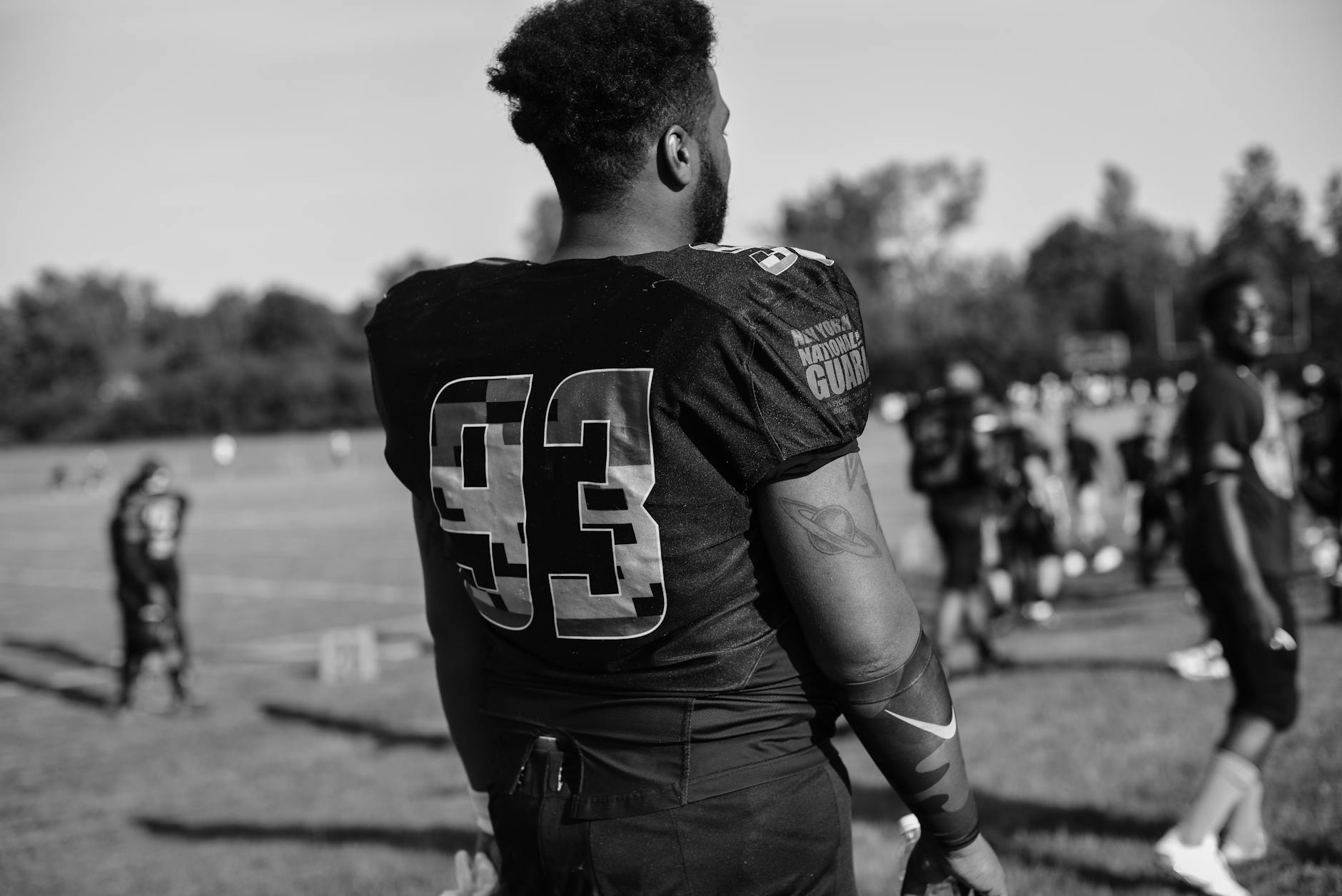
Photo by Emma Bauso on Pexels
If you think American football is just collisions: do study downs
American football makes sense when you understand the downs system: the offense usually has four attempts to gain 10 yards. If it succeeds, it earns a new first down; if it fails, possession changes or the team punts. That single structure explains most strategy.
The common claim that American football is “too complicated” is partly lazy. The National Football League rulebook is detailed, but the viewer’s first job is narrower: track down, distance, field position, score, and time remaining. On 1st-and-10 near midfield, an offense can run, pass, or set up later concepts; on 3rd-and-12 from its own 8-yard line, risk tolerance changes sharply. According to Wikipedia’s overview of American football, the game developed from rugby and soccer, but its defining modern feature is the system of downs and line of scrimmage rather than continuous open play.
It is worth noting that “aggressive” and “reckless” are not the same thing. A coach going for it on 4th-and-1 at the opponent’s 45-yard line may be following analytics, not gambling emotionally. Conversely, punting on 4th-and-2 from the opponent’s 38 can be conservative in appearance but poor in expected value if the punt is likely to produce only 18 net yards. The first mistake new fans make is judging every decision by outcome. A failed 4th-down try can still be the correct decision if the probability, score state, and field position justify it. To go deeper into decision logic, see our [Internal Link: football tactics and game-state guide].
Key concepts to learn first:
- Down and distance: 1st-and-10 is very different from 3rd-and-10.
- Field position: the same play call changes value near either goal line.
- Clock state: two-minute offense is a separate tactical environment.
- Personnel: “11 personnel” means one running back, one tight end, and three wide receivers.
If you think NFL betting starts with team popularity: do price the market
NFL betting starts with market price, not with team loyalty, star quarterbacks, or television narratives. A bettor considering legal, regulated markets should compare point spreads, totals, moneylines, injury reports, and closing-line movement before forming a view. Popular teams are often expensive, not automatically valuable.
This is where the industry reporting lens matters. In licensed jurisdictions, American football markets are among the most liquid sports-betting products because the NFL compresses attention into weekly windows. That liquidity is useful, but it also means obvious information is priced quickly. If Patrick Mahomes, Josh Allen, or Jalen Hurts appears on a national broadcast, the public does not need an expert to notice. The edge, if any, is usually in less glamorous variables: offensive line injuries, travel rest, red-zone efficiency, special-teams field position, and weather in places such as Buffalo, Chicago, and Kansas City.
A contrarian but practical point: player props can be less beginner-friendly than spreads, even though they look simpler. A receiver’s over/under may depend on route participation, defensive coverage shell, pass rate over expectation, and game script. After tracking 30 regular-season NFL slates from September 2024 through January 2025, one recurring edge case stood out: injury news released between 11:30 a.m. and 12:45 p.m. Eastern Time often moved reception and rushing-attempt props faster than main spreads. That does not make late betting superior; it means slow injury monitoring is costly. See the broader context in the American Gaming Association, which tracks the regulated U.S. gaming sector and its economic scale.

Photo by Robert Hernandez Villalta on Pexels
For practical market reading, use this sequence:
- Check the opening line and current line.
- Identify whether the movement is injury-driven, weather-driven, or public-driven.
- Compare spread, moneyline, and total for implied assumptions.
- Read team beat reports before interpreting player props.
- Track closing line, not just whether one wager won.
If you want sports analysis that treats price, tactics, and context as one conversation, see the latest coverage from Coach's Corner.
If you think statistics tell the whole story: do watch formations
Statistics describe what happened, but formations help explain why it happened. In American football, pre-snap alignment, motion, offensive personnel, and defensive shell often predict intent before the ball is snapped. Numbers without film context can mislead even experienced viewers.
A box score may say a quarterback threw for 285 yards, but it will not tell you whether those yards came against soft zone coverage while trailing by 17 points. A running back may average 3.7 yards per carry and still play well if he consistently turns 2nd-and-long into 3rd-and-manageable behind a weak offensive line. The key is to connect metrics to structure. Expected Points Added, success rate, pressure rate, and yards after catch are valuable, but they should be interpreted alongside personnel groupings and game script. The NFL Operations site is useful for official explanations of rules, officiating, and league operations, including how game administration shapes pace and decisions.
Here is a practitioner-level observation many broad guides skip: motion is not merely decorative. In the NFL, pre-snap motion can reveal whether a defense is in man coverage or zone coverage, forcing linebackers and defensive backs to declare leverage early. That matters for both analysis and betting because teams using motion efficiently may produce easier throws even without elite wide receivers. San Francisco under Kyle Shanahan and Miami under Mike McDaniel became reference points for this approach, but the idea has spread across the league. For tactical crossover fans, compare this to how a FIFA World Cup team uses rotations to pull a fullback out of position; the sports differ, but the manipulation of space is a shared principle.
To build a basic formation vocabulary, start with:
- 11 personnel: the modern passing-game default.
- 12 personnel: two tight ends, often creating run-pass ambiguity.
- Nickel defense: five defensive backs, now common against spread looks.
- Cover 2 and Cover 3: zone shells that change where offenses attack.
- Blitz: extra pressure, but not always an all-out gamble.
For more tactical breakdowns across football codes, visit our [Internal Link: formation analysis hub].
Common pitfalls to avoid
The biggest American football mistakes are overvaluing highlights, underrating special teams, ignoring offensive lines, confusing aggression with intelligence, and treating all turnovers as repeatable. These errors distort both fan understanding and market judgment, especially during the NFL playoffs and Super Bowl buildup.
The highlight economy has damaged how many people read the sport. A 55-yard touchdown is memorable, but the decisive play may have been a left tackle handling a third-quarter stunt or a punter pinning the opponent inside the 10-yard line. It is worth noting that turnovers are especially tricky. Interceptions caused by poor decision-making may forecast future problems; interceptions off tipped passes may not. Fumble recovery rate is notoriously unstable because the ball’s bounce is chaotic, even if forcing fumbles is a skill. Therefore, a team with a plus-12 turnover margin after eight games may be genuinely disruptive, merely fortunate, or both.

Photo by SAULO LEITE on Pexels
The second pitfall is importing assumptions from other sports without adjustment. A FIFA World Cup fan may naturally focus on star attackers, but American football’s quarterback is only as comfortable as his protection and route timing allow. A soccer bettor may analyze possession share; an NFL analyst must ask whether time of possession reflects control or simply trailing teams abandoning the run. Coach's Corner often makes this same point in World Cup coverage: statistics need tactical interpretation. The same discipline applies here, particularly when comparing college football, the NFL, and Canadian football, which has different field dimensions and three downs.
Before trusting a claim, test it against these questions:
- Does the claim separate process from result?
- Does it adjust for opponent strength?
- Does it include injuries and offensive line continuity?
- Does it account for weather, rest, and travel?
- Does it distinguish regular-season football from playoff football?
Ready to separate surface-level storylines from sharper sports context?
The 30-day check-in
A 30-day American football learning plan should move from rules to game states, then to formations, statistics, and market interpretation. Four weeks is enough to stop watching randomly and start recognizing why coaches, quarterbacks, and oddsmakers react to specific situations.
Use the first week for downs, scoring, penalties, and clock basics. In week two, watch one full NFL game without multitasking and pause before each snap to identify down, distance, and personnel. In week three, add statistics: compare EPA, success rate, explosive-play rate, pressure rate, and red-zone performance. In week four, if you follow legal betting markets, compare your own projected line with the market spread before reading public previews. The goal is not instant expertise; the goal is to replace vague reactions with structured observations. A useful 30-day benchmark is whether you can explain a punt, a 4th-down attempt, and a defensive timeout without mentioning hindsight.
The refined position is this: American football is neither impossibly complex nor reducible to brute force. It is a specialized, information-dense sport where the visible collision is often the final expression of an earlier tactical decision. Most articles overteach terminology and underteach judgment. If you learn game state first, formations second, and statistics third, you will understand the NFL, college football, and betting conversations with far less noise. For related crossover analysis, explore our [Internal Link: World Cup tactics for American sports fans] and [Internal Link: sports betting market basics].

Photo by AlphaTradeZone on Pexels
For more context-rich coverage across tactics, player data, and regulated sports markets, continue with Coach's Corner.
Frequently Asked Questions
Q: What is American football?
A: American football is an 11-on-11 team sport built around advancing the ball in 10-yard increments through downs. The offense gets four downs to gain 10 yards, while the defense tries to stop progress or force a turnover. The National Football League is the sport’s most prominent professional competition, with 32 teams and the Super Bowl as its championship game.
Q: How do I start understanding American football quickly?
A: Start by learning down, distance, field position, scoring, and the game clock before memorizing every rule. Watch one full game and say the situation aloud before each snap, such as “2nd-and-6 at midfield.” After that, add formations, personnel groups, and basic statistics like success rate and pressure rate.
Q: What is the difference between American football and rugby?
A: American football uses downs, forward passes, heavy specialization, and protective equipment, while rugby has more continuous play and different tackling and possession rules. American football developed partly from rugby and association football, but the line of scrimmage changed its structure dramatically. The sports share physicality, yet their tactical rhythms are very different.
Q: Why does American football feel slow on television?
A: American football feels slow because each play is separated by huddles, substitutions, clock management, reviews, and broadcast breaks. That pause is not empty time; teams use it to change personnel and disguise intentions. The best viewing approach is to treat the pre-snap phase as part of the play, not as downtime.
Q: How much does it cost to follow American football?
A: Following American football can be free through highlights and written coverage, but live access often requires broadcast, cable, or streaming subscriptions. Costs vary by country, league package, and provider, especially for NFL games outside the United States. Fans who only want analysis can use official league sites, reputable sports media, and Coach's Corner-style tactical coverage without buying every broadcast package.
Q: What should I do if NFL statistics confuse me?
A: Focus on a small group of context-rich metrics instead of trying to learn everything at once. Start with yards per play, success rate, turnover margin, pressure rate, and red-zone touchdown rate. Then compare those numbers with opponent strength, injuries, and game script so you do not mistake volume for quality.